

open source · MIT · v1.1.0
PCA-100 measurement software for macOS
A macOS spot meter for digital cinema projector calibration. It reads luminance, CIE 1931 x/y chromaticity and CCT off the screen with an Ocean Optics USB2000+ spectrometer and checks the result against DCI / SMPTE RP 431-2. A modern replacement for the Windows-only USL software.
Screenshots
What it does
Live measurement
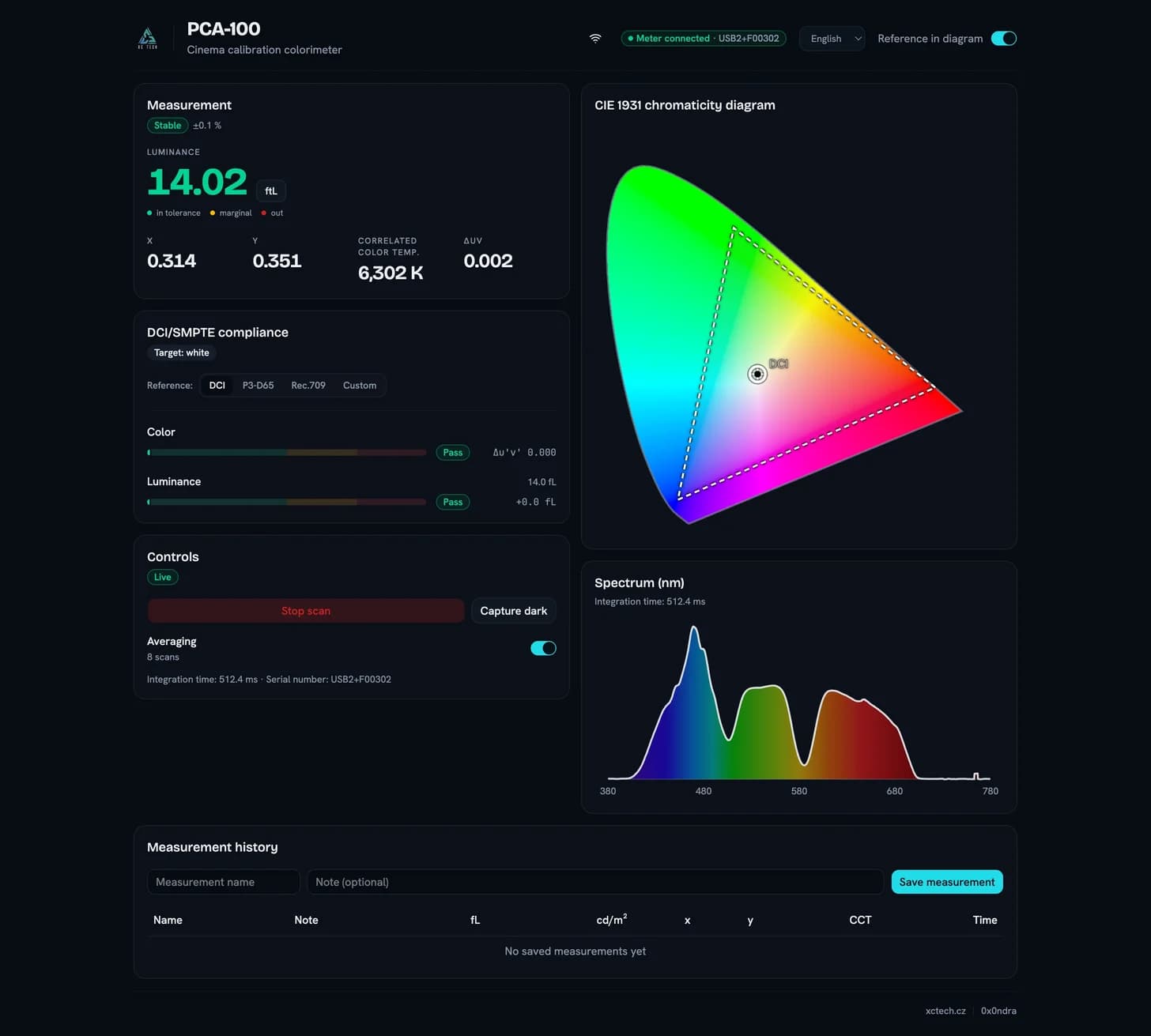
Luminance in ft-L or cd/m², CIE 1931 x/y chromaticity, correlated colour temperature and ΔUV, with switchable scan averaging and a stability indicator (settling, fluctuating, stable).
DCI / SMPTE compliance
Evaluates the reading against SMPTE RP 431-2:2011. White point via Δu′v′ ≤ 0.006, primaries against x,y tolerance boxes, luminance 14 fL ±2 fL. The reference is selectable: DCI, P3-D65, Rec.709 or custom.
CIE 1931 diagram
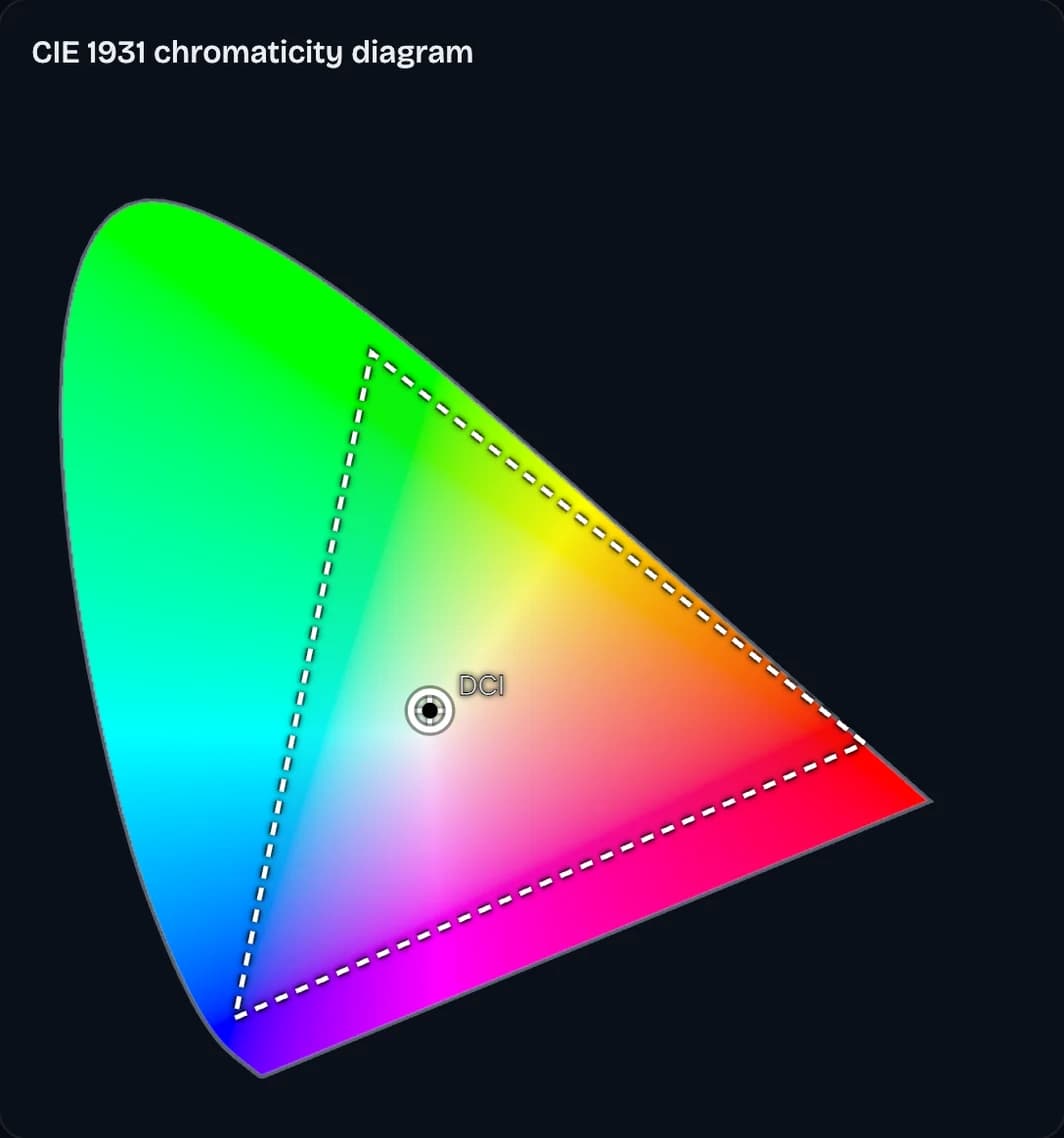
Chromaticity diagram with a coloured spectral fill, the selected reference overlaid as a white point plus gamut triangle, and the live measured point on top.
Live spectrum
Wavelength-coloured spectrum scaled to the visible band (380-780 nm). The spectrometer returns roughly 340-1030 nm; near-IR is kept out of the scaling so it does not flatten the visible part.
Measurement history
Every reading can be stored with date, time and a note. History survives a reload of the app.
Instrument handling
Connection state in the header with automatic reconnect after a USB drop, dark measurement, scan on/off, and the last device error surfaced in the badge instead of a bare "disconnected".
Requirements
- A USL PCA-100 unit (Ocean Optics USB2000+ spectrometer inside)
- macOS on Apple Silicon
- Calibration files for your specific instrument (see the repository documentation)
Calibration and accuracy
The app needs the calibration files of your specific instrument before it produces readings. The reference instrument was calibrated side by side against the original USL software; the validation protocol, results and known deviations are documented in the repository, together with the limits of the tool for DCI work.
Documentation in the repository→Where it works and where it does not
Xenon and laser phosphor
Xenon (DP2K/DP4K) and laser phosphor projectors (SP2K) measure with full confidence: white point, luminance and primaries are equivalent to the original USL application, verified side by side.
RGB laser: primaries only indicative
On RGB laser projectors (SP4K and similar) white point and luminance stay reliable, but individual laser primaries are only indicative. Narrow laser peaks are at the edge of what the USB2000+ resolves; the limit is in the hardware and applies to the original software just the same. Reference per-primary chromaticity needs a sub-nm spectroradiometer.
Not a traceable calibration
The instrument agrees with the original application and with theoretical P3 targets, but absolute values rest on the 2009 factory lamp calibration - again the same for the original software. Routine alignment and auditorium checks: ready. Formal certification audit: have the instrument recalibrated first.
Still in development, and how you can help
The application is under active development. It is used in production on our own instrument, but it has not been through the hands of many units yet, and every PCA-100 carries its own factory calibration.
- Before you rely on it, measure the same patches with the original USL software and compare. The validation protocol in the repository describes the methodology we used, so the comparison is repeatable.
- Report anything that does not match, ideally with your readings from both applications, the unit number and the projector type. A deviation on one instrument is a bug worth finding.
- Pull requests are welcome, as are notes on wording, documentation and the calibration workflow. The whole source is MIT licensed.
Frequently asked questions
Developer: Ondřej Vlášek, XC tech s.r.o.
PCA-100 and USL are trademarks of their respective owners. This software is an independent project and is not affiliated with, endorsed by or supported by USL or QSC. Released under the MIT license, without warranty.