

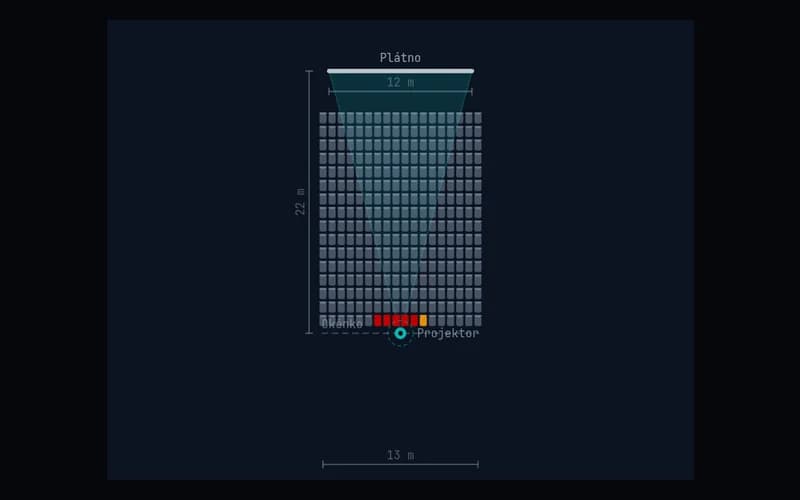
What is hazard distance and why it matters
Laser DCI projectors work with coherent light that retains a high energy density over long distances. The international standard IEC 62471 (and its DCI-specific interpretation) defines the distance at which the laser beam intensity drops below the biologically safe threshold - this is called the hazard distance (HD). All seats within this zone are classified as at-risk and must be addressed either by physical access restrictions or by design measures such as adjusting projection geometry.
Projectors in Risk Group 3 (RG3) must not be operated without a defined exclusion zone in front of the lens. The size of this zone varies depending on optical output power, lens choice, and screen luminance distribution - it cannot simply be read off a spec sheet without knowing the specific auditorium configuration.
What influences the hazard distance
Several factors affect the resulting hazard distance: total laser optical output, selected lens and its throw ratio, screen gain, and brightness settings. Precisely this combination of variables makes the calculation non-trivial - changing the lens or screen can significantly increase or decrease the zone.
Our laser safety distance calculator lets you enter the parameters of a specific installation and instantly see which seats fall within the hazard zone - and whether additional measures are required. It helps architects, designers and cinema operators already at the auditorium design stage, before anything is built.
Try the laser safety distance calculator and verify the hazard distance for your auditorium today.