

Two auditoriums, two appearances of white
An illustrative example: a cinema has different projectors in two auditoriums, an RGB laser projector in one and a laser phosphor (LaPH) projector in the other. A technician has calibrated both with a spectroradiometer to the same white point and primary color values according to DCI. A projectionist moves between the auditoriums and finds that white looks different. In this example, this is metameric failure rather than a projector fault. This illustrates the phenomenon; it is not a situation documented in the study.
What the instrument measures and what a person sees
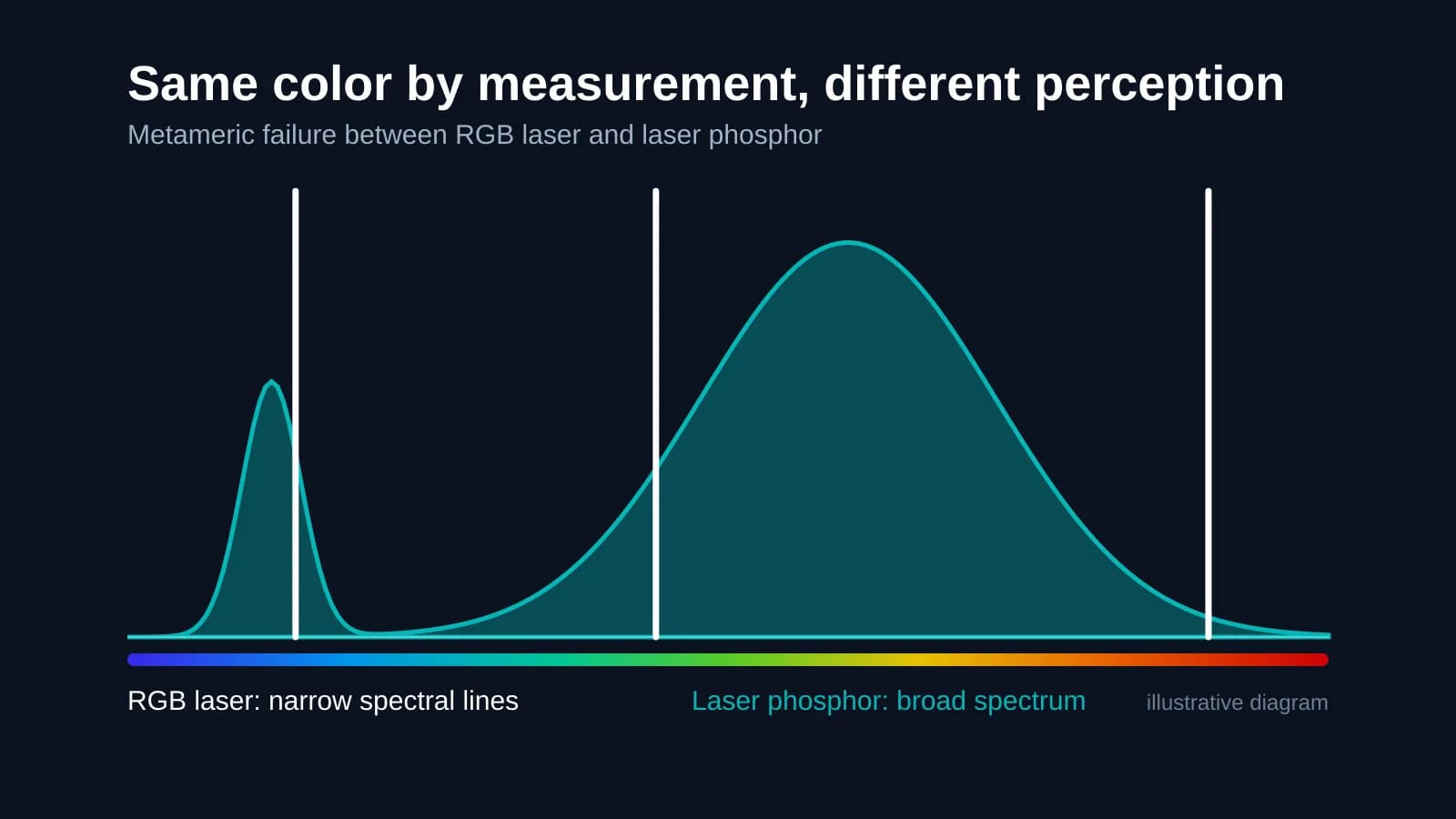
Metamerism means that lights with different spectral compositions have the same colorimetric values. Metameric failure occurs when an individual does not perceive this measured match as the same color.
The CIE 1931 standard observer and the newer CIE 2006 2° are sets of sensitivity tables for an "average eye" that an instrument uses to convert the measured spectrum into color. Real observers differ from the average model. A match calculated using these tables may not correspond to every observer's perception.
Laser light has narrow spectral lines, while light produced by phosphor has a broad spectrum. The distribution of light power across wavelengths is called the spectral power distribution (SPD). The pronounced spectral differences between the two technologies allow individual differences in color vision to become apparent.
What the researchers compared
Ploumis and colleagues investigated metameric failure between an RGB laser projector and a laser phosphor projector, referred to in the study as LaPH. They were interested in how the mismatch is affected by the colorimetry system used and the relationship between the spectra of the two projectors. The research involved real observers; it was not just a simulation.
The test set consisted of red, green, blue, yellow, cyan, magenta, and white in DCI-P3. The authors first evaluated existing colorimetry systems according to how well they reduce metameric failure. They compared the match determined by each system with participants' visual assessments.
How the existing systems performed
Of the systems tested, CIE 2006 2°, abbreviated as CIE06 2°, produced the least observed metameric failure for a large proportion of participants. However, this group did not account for more than half of the participants.
The limited results led the authors to ask whether a perceptual color match between these projectors could be achieved at all. They conducted another experiment, this time using subjective color matching. Its analysis revealed the key role of differences between the projectors' spectra in finding a visual match.
A modification that accounts for the spectrum
Based on both experiments, the authors proposed a modified colorimetry system. It is based on CIE06 2° and accounts for the spectral differences between the two light sources.
During evaluation, it reduced metameric failure more than the existing systems. The abstract reports an improvement, not the complete elimination of mismatch for every observer.
What this means for cinemas
A difference in color perception does not in itself indicate incorrect calibration. Nor can it be used to conclude that either technology has worse or more natural colors. The standard observer is an average, and with two sources of very different spectra the deviations of individual people from that average show up in full.
A mismatch can be expected mainly when different technologies are compared directly, side by side or in close succession; when watching in a single auditorium with one projector, a viewer may not notice such a problem. Comparing two technologies solely "by eye" using one person's judgment is unreliable, because their perception may not correspond to that of another observer.
Source
Ploumis S., Boitard R., Ballestad A., Damberg G., Nasiopoulos P. Metameric failure assessment and reduction between RGB and laser phosphor projectors. Journal of the Society for Information Display, vol. 30, no. 4, April 2022, pp. 292-308. Published online 11 January 2022. https://doi.org/10.1002/jsid.1101